From the Dean of Learning and Teaching
I'll Start in Five Minutes…
There is a familiar scene in many households on a school afternoon. A student sits down to complete his homework. He opens his laptop, checks a message, decides he needs a snack (or three), notices a soccer ball, remembers something he wanted to look up and, before long, discovers that an impressive amount of time has passed without much work being completed.
For parents, this can be frustrating to watch. Particularly when the young person in question is perfectly capable of completing the task.
But what if procrastination is not simply a matter of laziness or poor time management?
A recent article in The Conversation, 72% of students say they procrastinate. Here's how to stay on track, invites us to think more carefully about why students put off their work and what might help them develop more productive learning habits.
This is particularly relevant at Lauries, where a recent survey of nearly 900 students has provided some interesting insights into how our young men approach their learning.
Ambition Is Not the Problem
One of the most encouraging findings from our survey was the strength of students' academic aspirations.
Of the 854 students who responded to a question about their learning goals, 538 (63%) indicated that they wanted to achieve the very best results they were capable of. A further 134 students (16%) wanted to achieve strong results, even if these were not necessarily their personal best.
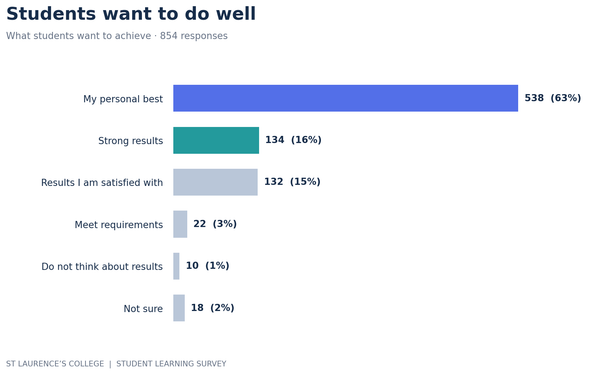
In other words, nearly four in five students expressed a desire to achieve strong academic outcomes.
Yet their responses to questions about managing schoolwork revealed a rather different picture.
- 476 students reported relying on their memory to remember homework, reminders or tasks.
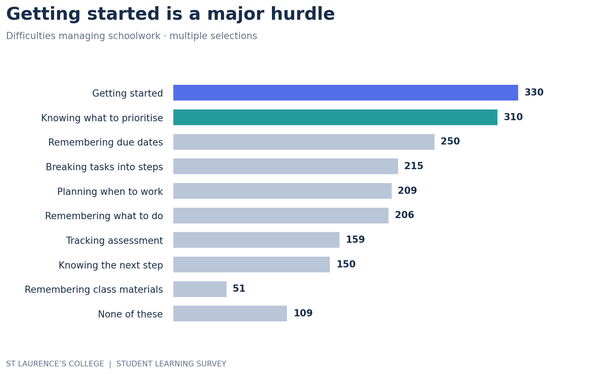
- 330 students identified getting started on work as something they sometimes found difficult.
- 310 students reported difficulty knowing what to prioritise.
- 250 students sometimes struggled to remember when work was due.
215 students found breaking larger tasks into smaller steps difficult.
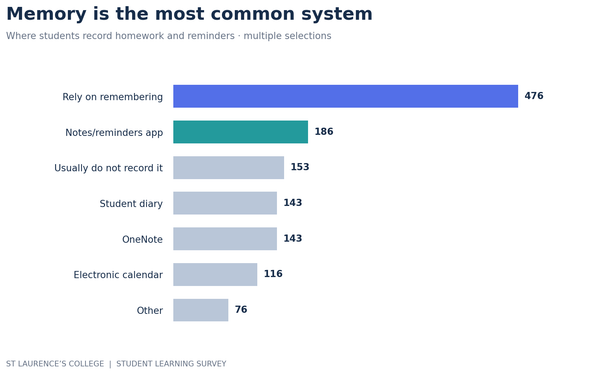
These responses reveal an important distinction between wanting to succeed and knowing how to organise ourselves to succeed.
A student can be ambitious, capable and genuinely committed to his education while still struggling to begin an assignment, organise competing demands or manage his time effectively.
Why We Put Things Off
Procrastination is often described as a failure of time management. However, research increasingly points to the role of emotions in our decisions about when to begin difficult or uncomfortable tasks.
An assignment might feel overwhelming because the student does not know where to start. A challenging mathematics problem might threaten his confidence. An extended writing task might create anxiety about whether the finished product will be good enough.
Avoiding the task provides temporary relief from that discomfort. Unfortunately, it also makes the task more pressing, and often more stressful, as the deadline approaches.
This helps explain why simply telling a teenager to 'get organised' or 'stop procrastinating' may have limited effect. The challenge is not always a lack of motivation. Sometimes, it is knowing how to translate motivation into action.
What Can Parents Do?
There are several practical ways families can help young people develop the habits that make independent learning possible.
- Make the first step smaller. Rather than asking, 'Have you finished your assignment?', try asking, 'What's the first thing you need to do?' Opening a document, writing a heading or completing one question can be enough to overcome the initial resistance to starting.
- Move reminders out of their heads. Our survey suggests that many students continue to rely on memory to manage their responsibilities. Encourage your son to use a consistent system, such as the College Diary. The goal is not to remember everything, but to develop a reliable way of keeping track of what matters.
- Help him decide what comes first. When several tasks compete for attention, young people can become overwhelmed. A brief conversation about what is most urgent, what will take the longest and what can be completed quickly can help make the workload more manageable.
- Focus on starting, rather than finishing. Encourage your son to commit to just ten minutes of focused work. Once he has begun, continuing often feels considerably easier. A short period of genuine concentration is more valuable than an hour spent sitting at a desk while avoiding the task.
- Recognise progress, not just results. Notice when your son starts an assignment early, uses a planner independently or perseveres with something difficult. These behaviours are worth acknowledging because they are the foundations of effective learning.
Building the Habits of Independent Learners
At Lauries, our interest in these survey findings extends beyond homework completion. They invite us to consider how explicitly we teach the skills that allow students to manage their learning with increasing independence.
Organisation, planning, prioritisation and perseverance are not simply personal qualities that some students possess and others lack. They are habits and strategies that can be taught, practised and strengthened over time.
As we continue developing our approach to learning at the College, these student insights will help inform how we support young men to become more deliberate, confident and independent learners.
Perhaps the most useful question we can ask a young person who is putting off his schoolwork is not, 'Why haven't you finished?'
It might simply be, 'What would help you get started?'
MS GRACE VISSER
Dean of Learning & Teaching