From the Dean of Learning and Teaching
If everybody in the room agrees with you, you’re in the wrong room.

Every second Tuesday, I have the privilege of joining the top 20 students from Years 9 to 12 and their parents for our Academic Breakfast. It is a time to share a meal, connect across year levels, and engage in discussion around an advanced or executive-level topic. This week, I spoke about a theme that sits at the heart of learning and leadership: Debating with Respect.
I began by exploring historical examples where organisations lacked a culture of open debate: the Challenger Space Shuttle disaster, the Bay of Pigs invasion, the sinking of the Titanic, the Fukushima nuclear crisis and the Volkswagen emissions scandal. In each case, fear of dissent, overconfidence, or the desire for consensus silenced critical voices, leading to catastrophic outcomes. These moments in history remind us that progress and safety depend on our willingness to challenge ideas, not simply agree with them.
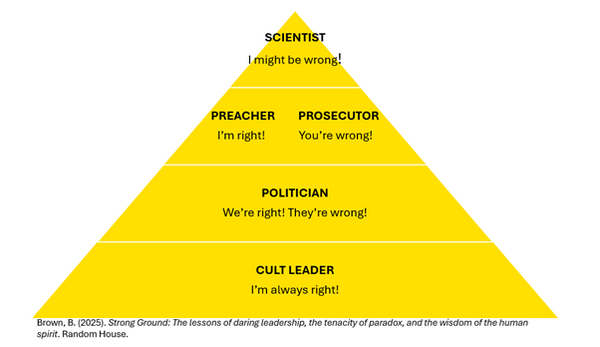
Drawing on Brené Brown’s “Think Like a Scientist” triangle from Strong Ground, I encouraged students to approach disagreement with curiosity rather than defensiveness – to see debate not as conflict, but as an opportunity for discovery. Thinking like a scientist invites us to test ideas, listen deeply, and remain open to being changed by what we learn.
I closed the presentation with a simple three-step framework for respectful communication:
- Clarify: seek to understand before responding.
- Summarise: demonstrate that you’ve genuinely heard the other person.
- Validate: acknowledge their feelings or perspective, even if you disagree.
These steps, clarify to understand, summarise to connect, and validate to build trust, remind us that respectful debate is not about winning an argument, but about strengthening relationships and deepening understanding.
I did suggest to parents that this framework might be helpful at the dinner table when your teenager insists that homework can, in fact, be done “later.”
Reference
Brown, B. (2025). Strong ground: The lessons of daring leadership, the tenacity of paradox, and the wisdom of the human spirit. Random House.
MS GRACE LOYDEN
Dean of Learning & Teaching